Stablecoin rails vs SWIFT: how cross-border payments compare
SWIFT routes cross-border payments through a network of correspondent banks. Stablecoin rails settle value on-chain. Here is how the two approaches compare on speed, cost and reach.
Damex, Editorial team4 min read
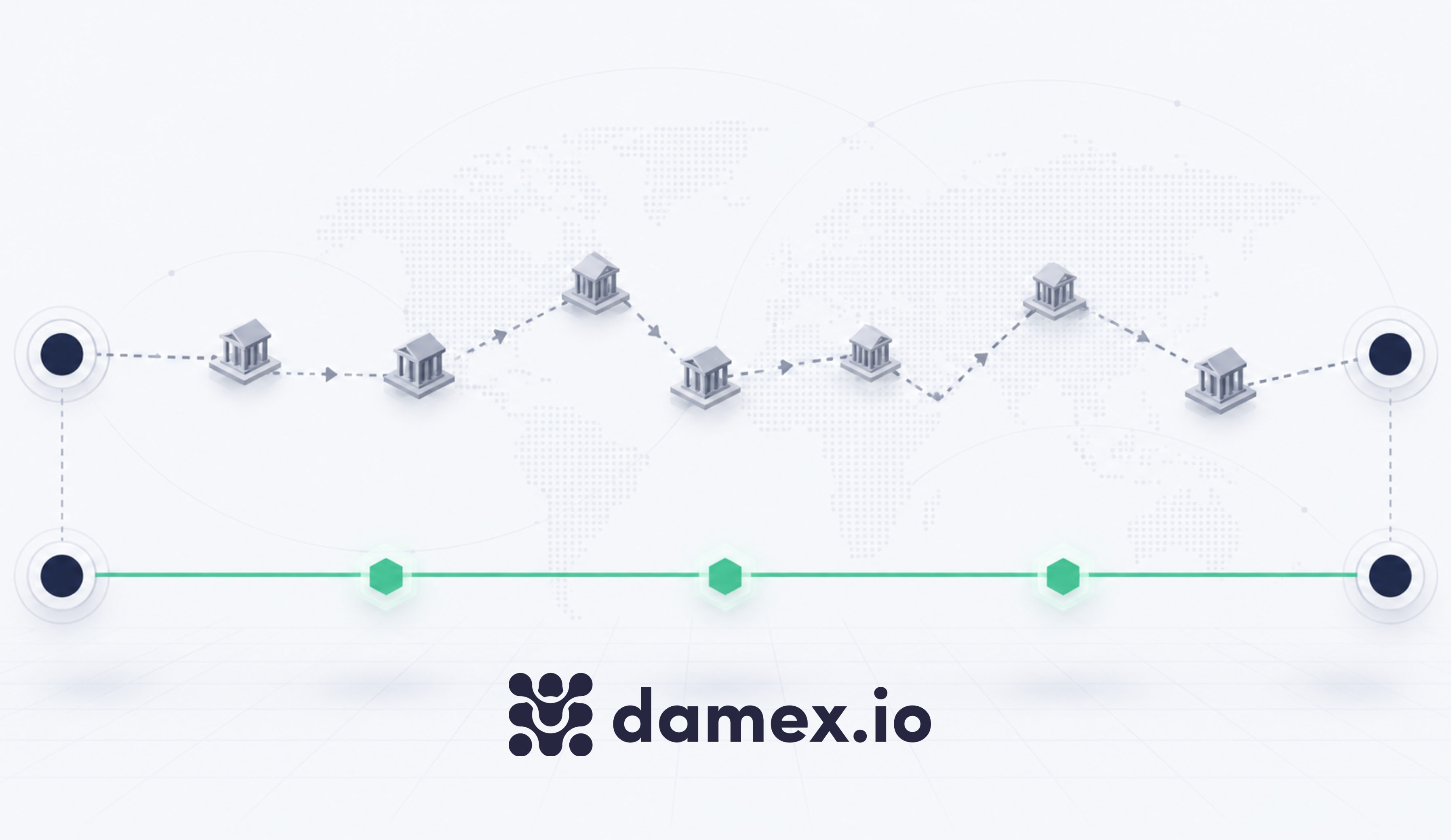
SWIFT is a messaging network that instructs banks how to move money across borders, with the payment itself settling through a chain of correspondent banks. Stablecoin rails move value directly over a public blockchain, without that chain. The core difference is structural: SWIFT coordinates intermediaries, while stablecoin rails remove them, which is what changes the speed and cost profile.
What SWIFT actually is
A common misconception is that SWIFT moves money. It does not. SWIFT is a secure messaging system that tells banks what to do. The money still moves through correspondent banking relationships between those banks. Each correspondent in the path can add a step, a fee and a delay, and the final cost is often not visible to the sender at the start.
What stablecoin rails are
Stablecoin rails settle value on a public blockchain. Fiat is converted to a stablecoin, the stablecoin settles on-chain to the destination, and it is converted back to local fiat. There is no correspondent chain in the middle, which is where much of the traditional cost and delay comes from. This is the basis of cross-border settlement with stablecoins.
How they compare
- Settlement: SWIFT relies on sequential correspondent settlement, which can take days. The on-chain transfer leg of stablecoin rails is near real-time, though end-to-end time still includes conversion and any required checks.
- Cost: SWIFT payments accumulate fees across correspondents. Stablecoin rails move value over a single set of rails, which can reduce cost, depending on the corridor and assets.
- Reach: SWIFT reach depends on correspondent coverage, which is thin in some emerging markets. Stablecoin rails are designed to reach corridors where correspondent coverage is limited.
- Transparency: SWIFT paths and total costs are often opaque to the sender. On-chain settlement is visible on the blockchain.
- Regulatory framework: both must operate within the applicable rules. Regulated stablecoin infrastructure delivers on-chain settlement inside a regulated framework such as MiCA in the EU.
When each fits
SWIFT remains deeply embedded and universal across the banking system. Stablecoin rails are designed to add speed, cost and reach advantages on specific corridors, particularly emerging markets and high-frequency flows. For many businesses the practical question is not one or the other, but which corridors move better over stablecoin rails.
Does using stablecoin rails mean holding crypto?
Not necessarily with regulated infrastructure. The business works with fiat and stablecoin balances through accounts and APIs, while the provider manages the digital assets and custody. The stablecoin is the settlement mechanism, not an asset the business has to hold. This is one part of stablecoin infrastructure.
Frequently asked questions
Is SWIFT the same as the money moving?
No. SWIFT is a messaging network that instructs banks. The payment settles separately through correspondent banking relationships between those banks.
Are stablecoin rails faster than SWIFT?
The on-chain transfer leg is near real-time, compared with the days a correspondent chain can take. End-to-end time on stablecoin rails still includes conversion and any required checks, so it varies by corridor.
Are stablecoin rails cheaper than SWIFT?
They can be, because value moves over a single set of rails rather than accumulating fees across correspondent banks. Actual cost depends on the corridor and assets involved.
Do stablecoin rails replace SWIFT?
Not wholesale. SWIFT is universal across banking. Stablecoin rails add advantages on specific corridors, so many businesses use them alongside existing rails rather than as a full replacement.
Disclaimer
This article is for information and discussion purposes only. It does not constitute financial, investment, tax or legal advice, and should not be relied upon as such. Crypto-assets and stablecoins carry risk, including the risk of loss. Availability of Damex services depends on your jurisdiction and is set out in the relevant terms and conditions. Services are provided by different Damex entities under different regulations by region.
Related reading
How to enter the EU crypto market without your own licence
A non-EU business does not always need its own MiCA licence to serve EU clients. Here are the practical routes, and how working with an authorised partner compares to applying directly.
4 min read
MiCA licence vs MiCA partner: which route into the EU is right for your business?
A MiCA licence and a MiCA-authorised partner are two routes to serving EU crypto-asset markets. One means applying for your own authorisation; the other means operating through a partner that already holds it. Here is how they compare.
4 min read
On and off ramps explained: moving between fiat and stablecoins
An on-ramp turns fiat into stablecoins; an off-ramp turns them back. They are the entry and exit points of stablecoin infrastructure. Here is how they work and what good ramps provide.
3 min read
Talk to the team building regulated settlement rails
Tell us about your flows and we will map the right Damex setup for your business.