What is stablecoin infrastructure?
Stablecoin infrastructure is the regulated layer that lets businesses settle over stablecoin rails while keeping predictable, fiat-backed balances. Here is how it works and why financial institutions are adopting it.
Damex, Editorial team5 min read
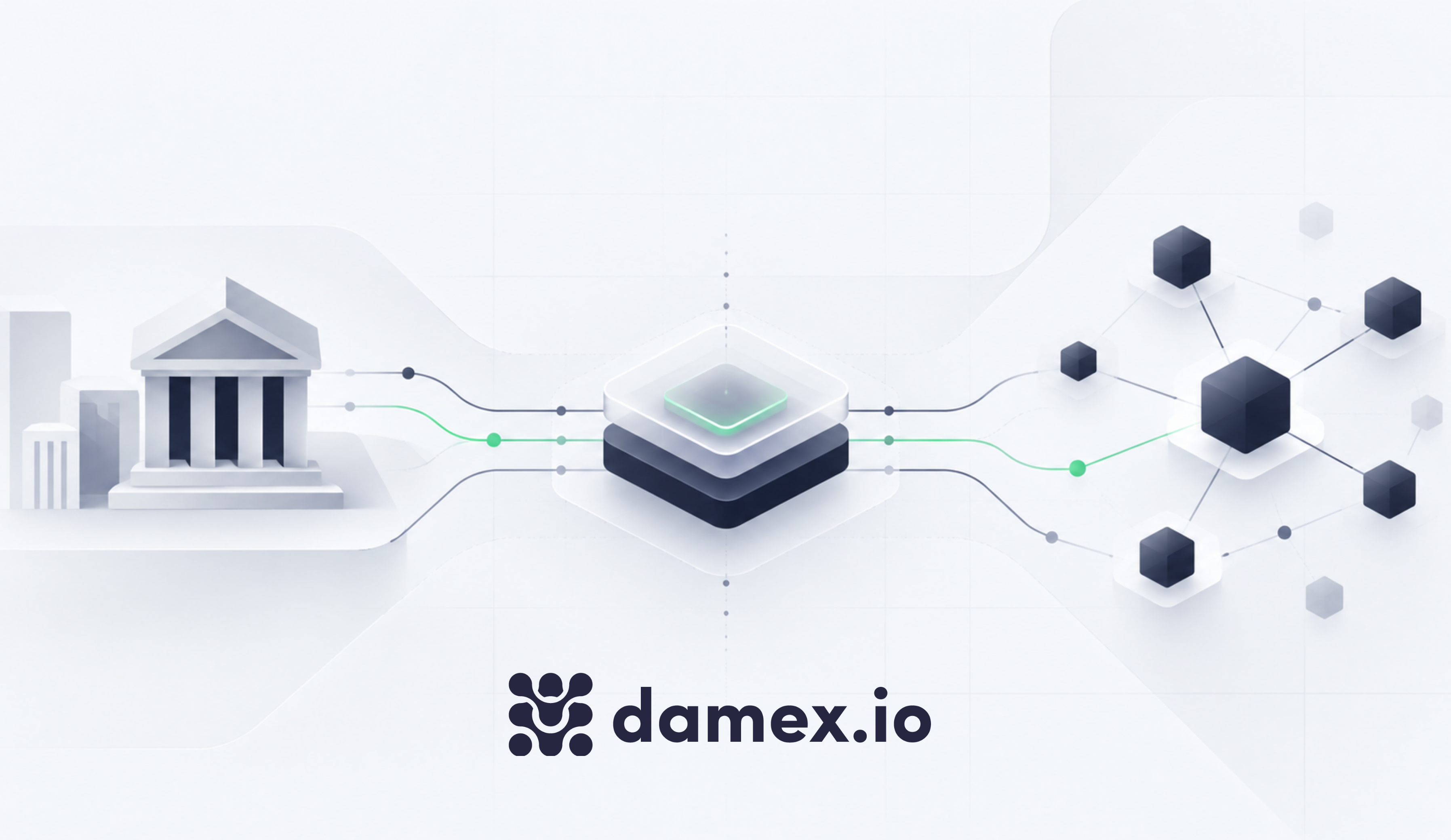
Stablecoin infrastructure is the regulated software and settlement layer that lets businesses send, receive, convert and hold value over stablecoin rails, without managing blockchains, custody or crypto exposure themselves. It sits between traditional finance and public blockchains, exposing familiar tools such as accounts, APIs and payouts while the stablecoin mechanics run underneath.
Stablecoin infrastructure in one sentence
It is the layer that turns stablecoins into something a finance team can actually use. A business connects through an API or an account, moves fiat or stablecoins, and settles, while the provider handles conversion, custody, liquidity and the regulatory framework around it.
Why "infrastructure" and not just "stablecoins"
A stablecoin on its own is only a token that tracks the value of a currency such as the US dollar or the euro. Holding one does not give a business a way to collect from customers, pay suppliers in another country, reconcile against an ERP, or stay within a regulated framework.
Infrastructure is everything that makes the token usable at business scale:
- Accounts for fiat and stablecoins, including IBANs where available.
- Conversion between fiat and stablecoins, so value can enter and leave the system.
- Custody of the underlying assets under a regulated framework.
- Payout and collection rails that reach counterparties across borders.
- Liquidity to price and execute larger transactions.
- APIs that let existing treasury and payment systems plug in.
Without this layer, a company would have to assemble custody, liquidity, conversion and regulatory coverage from separate providers. Stablecoin infrastructure combines them into one platform.
How stablecoin settlement works
A typical cross-border flow looks like this. A business receives or holds fiat. That value is converted to a stablecoin and moves over a public blockchain to the destination, where it is converted back to local fiat and paid out. The blockchain step is what removes the dependency on correspondent banking chains.
Because the transfer settles on-chain rather than through a sequence of intermediary banks, it is designed to settle faster than legacy rails and to reduce the fees that accumulate across correspondent banks. The exact speed and cost depend on the corridor, the assets and the rails involved.
Do businesses need to hold volatile crypto to use it?
No. This is the point that matters most to finance teams. With regulated stablecoin infrastructure, a business can leverage instant blockchain settlement using cash-equivalent, fiat backed digital assets, maintaining predictable cash-equivalent balances on their balance sheet. The provider manages the digital assets and custody and wallet infrastructure behind the scenes, allowing your team to interact through familiar accounts and APIs without managing private keys or raw and volatile crypto assets.
Where regulation fits
Stablecoin infrastructure is only relevant to institutions if it operates within a regulated framework. In the European Union, the Markets in Crypto-Assets regulation, known as MiCA, sets the rules for crypto-asset service providers. Crypto-asset services and traditional payment services such as IBAN and e-money services fall under separate frameworks and are provided by different entities.
Damex provides this layer as regulated stablecoin infrastructure. Services are offered by different Damex entities under different regulations by region, including Digital Asset Management Ltd, authorised by the GFSC in Gibraltar, and Damex Digital Ltd, registered with the MFSA in Malta as a CASP under MiCA and a Financial Institution to handle Electronic Money Tokens.
Who uses stablecoin infrastructure
Three groups adopt it first:
- Financial institutions evaluating regulated stablecoin rails, where trust and regulatory coverage are the gatekeepers.
- PSPs and fintechs that want API-first settlement and treasury tools that integrate into existing systems.
- High-volume cross-border businesses moving money across markets every day, where settlement speed and FX cost have a direct impact.
Frequently asked questions
Is stablecoin infrastructure the same as owning stablecoins?
No. Owning a stablecoin is holding a single token. Infrastructure is the full set of accounts, rails, conversion, custody and regulatory coverage that makes stablecoins usable for business payments.
Do you need crypto exposure to use stablecoin rails?
No. Regulated infrastructure allows businesses to tap into fast, 24/7 blockchain settlement while keeping balance sheet values pegged to fiat. Because the provider manages the underlying custody and technical management, your finance team avoids price volatility and the operational burden of managing raw digital assets.
Is stablecoin infrastructure regulated?
It can be. Compliant stablecoins within the European Union must be issued as Electronic Money Tokens. Providers operate within frameworks such as MiCA in the European Union, with crypto-asset services and payment services delivered under separate regulations and entities. Always check which entity and regulator cover a given service and asset.
Disclaimer
This article is for information and discussion purposes only. It does not constitute financial, investment, tax or legal advice, and should not be relied upon as such. Crypto-assets and stablecoins carry risk, including the risk of loss. Availability of Damex services depends on your jurisdiction and is set out in the relevant terms and conditions. Services are provided by different Damex entities under different regulations by region.
Related reading
MiCA passporting explained: one authorisation, the whole EU
MiCA passporting lets a firm authorised in one EU member state provide its services across the others. Here is how it works and why it matters for market access.
3 min read
How to integrate stablecoin payments into B2B payment workflows
Integrating stablecoin payments into a B2B workflow means connecting onboarding, accounts, conversion, payouts and reconciliation through an API. Here is the step-by-step path for finance and product teams.
4 min read
Benefits of stablecoin payments for businesses: 24/7 settlement vs wire transfers
For businesses, stablecoin payments offer around-the-clock settlement, clearer cost visibility and global reach compared with traditional wire transfers. Here is what that means for CFOs and treasury teams.
5 min read
Talk to the team building regulated settlement rails
Tell us about your flows and we will map the right Damex setup for your business.