Cross-border settlement with stablecoins, explained
Stablecoin rails let businesses settle across borders without a chain of correspondent banks. Here is how cross-border stablecoin settlement works and where it reduces cost and delay.
Damex, Editorial team4 min read
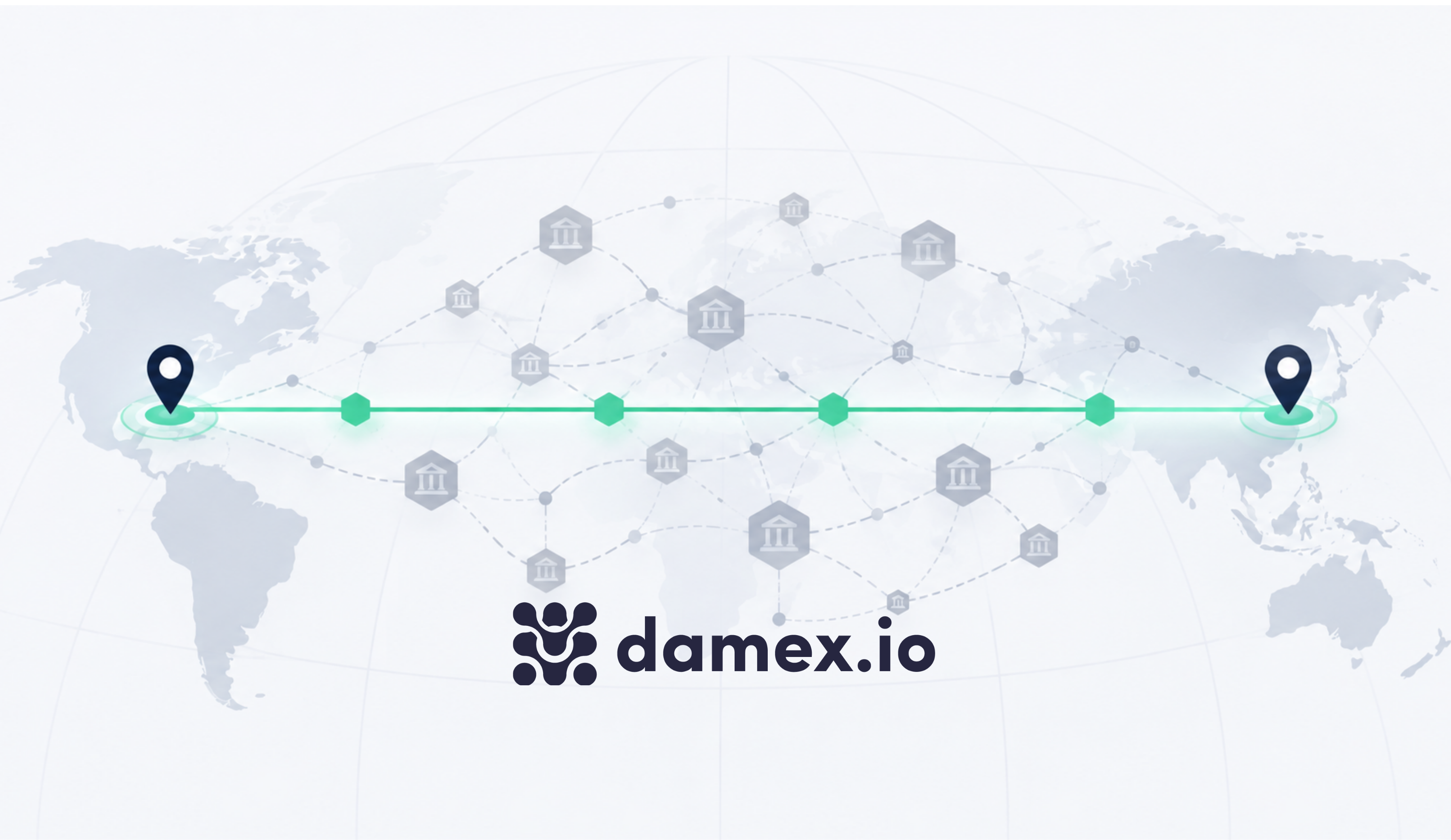
Cross-border settlement with stablecoins is the process of moving value between countries over stablecoin rails instead of through a chain of correspondent banks. Fiat is converted to a stablecoin, the stablecoin settles on a public blockchain, and it is converted back to local fiat at the destination. Removing the intermediary bank chain is what reduces delay and cost.
How the legacy path works, and why it is slow
A traditional cross-border payment often passes through several correspondent banks. Each one adds a step, a fee and a potential delay, and settlement can take days. The sender rarely sees the full path or the total cost in advance. This is the friction that stablecoin settlement is designed to remove.
How stablecoin settlement works
The flow has three stages:
- On-ramp: the sender's fiat is converted to a stablecoin, such as an e-money token referencing the euro or the US dollar.
- Transfer: the stablecoin moves over a public blockchain directly to the destination, without correspondent banks in between.
- Off-ramp: the stablecoin is converted to local fiat and paid out to the recipient.
Because the transfer stage settles on-chain, it is designed to settle faster than legacy rails and to avoid the fees that accumulate across intermediary banks. Actual speed and cost depend on the corridor, the assets and the rails involved.
Where it reduces cost and delay
The clearest gains show up in specific situations:
- Payouts to emerging markets, where correspondent banking coverage is thin and slow.
- High-frequency cross-border flows, where per-transaction fees and delays compound.
- Corridors with high FX spreads, where converting once over stablecoin rails can reduce the cost of moving between currencies.
What "settlement" means here
Settlement is the point at which value is final and available to the recipient. On stablecoin rails, the on-chain transfer settles quickly, though the full end-to-end time still includes the on-ramp and off-ramp steps and any checks required by the regulated framework. It is near real-time on the transfer leg, not instant end to end for every corridor.
Do businesses need to take on crypto to do this?
Not necessarily when considering the implementation of regulated infrastructure. The business works with fiat and stablecoin balances through regulated accounts and APIs, while the provider handles the digital assets, custody and liquidity. The stablecoin is a settlement mechanism inside the flow, not something the business has to hold on its balance sheet.
Frequently asked questions
What is cross-border settlement with stablecoins?
It is moving value between countries over stablecoin rails rather than through correspondent banks. Fiat is converted to a stablecoin, settled on a blockchain, and converted back to local fiat at the destination.
Why is it faster than traditional cross-border payments?
Traditional payments pass through a chain of correspondent banks, each adding a step, fee and delay. Stablecoin settlement removes that chain by transferring value directly on-chain.
Does it reduce FX costs?
It can, particularly on corridors with high spreads or thin correspondent coverage, because value moves over a single set of rails. Actual savings depend on the corridor and assets.
Is settlement instant?
The on-chain transfer leg is near real-time. End-to-end time still includes conversion on and off the rails and any checks required by the regulated framework, so it varies by corridor.
Disclaimer
This article is for information and discussion purposes only. It does not constitute financial, investment, tax or legal advice, and should not be relied upon as such. Crypto-assets and stablecoins carry risk, including the risk of loss. Availability of Damex services depends on your jurisdiction and is set out in the relevant terms and conditions. Services are provided by different Damex entities under different regulations by region.