How stablecoin payouts reach emerging markets
Emerging markets are where legacy payout rails are slowest and thinnest. Here is how stablecoin payouts reach these markets, and what to check before relying on them.
Damex, Editorial team4 min read
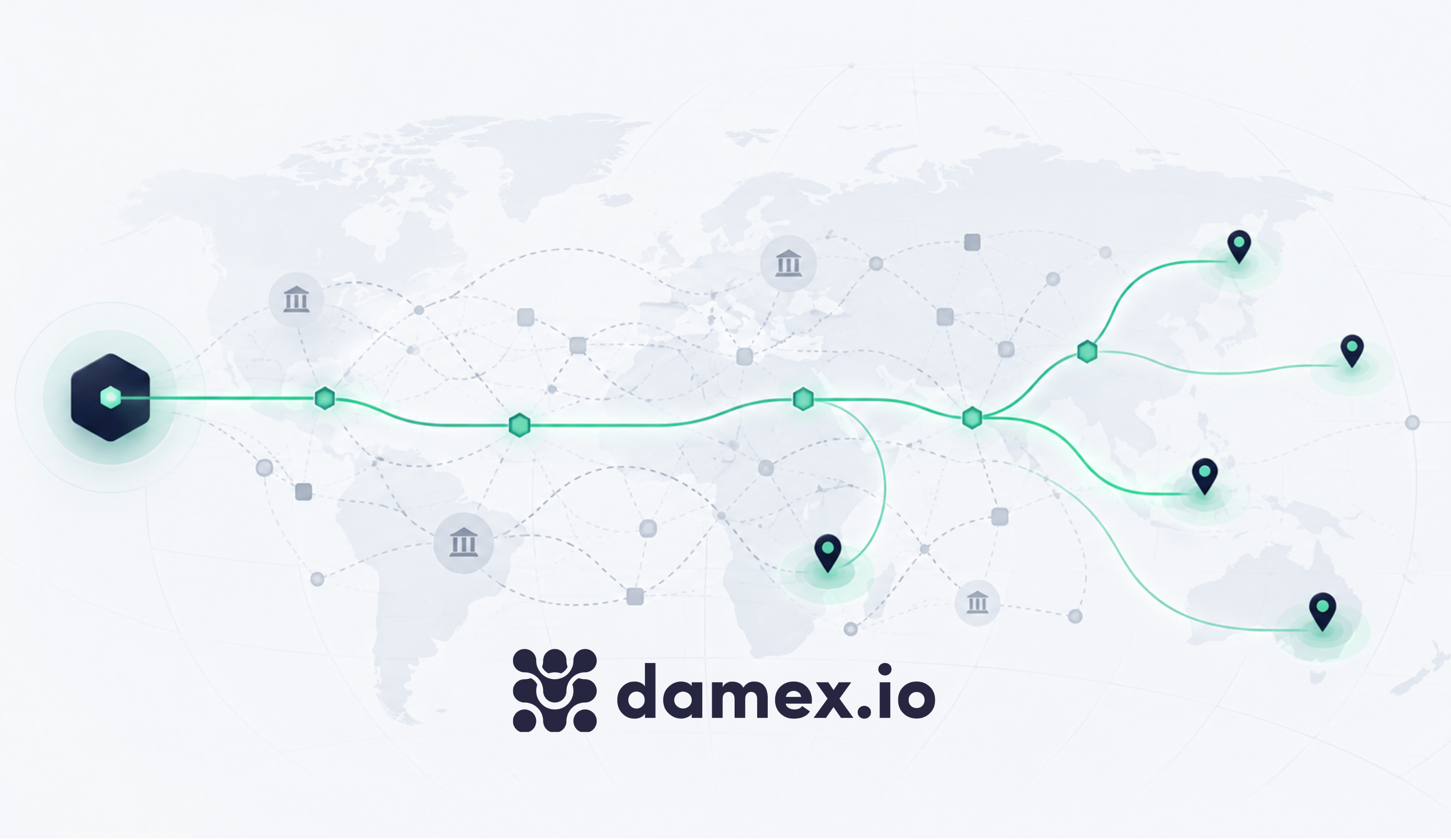
Stablecoin payouts reach emerging markets by moving value over public blockchain rails and converting to local currency at the destination, instead of depending on correspondent banks that often have thin or slow coverage in those regions. This makes it possible to pay recipients in markets that legacy rails struggle to serve quickly or affordably.
Why emerging markets are hard for legacy rails
Correspondent banking works by chaining banks together across borders. In major corridors those chains are dense and efficient. In many emerging markets they are not: there may be few correspondent relationships, longer settlement times, higher fees, and less visibility over whether a payment has arrived. For a business paying suppliers, contractors or partners in these markets, that friction is a real operational cost.
How a stablecoin payout works
The flow mirrors any stablecoin settlement, with the destination being the key part:
- Value is converted to a stablecoin on the sending side.
- The stablecoin moves over a public blockchain directly, without a correspondent chain.
- At the destination it is converted to local fiat and paid out to the recipient, or held as a stablecoin balance where that is useful.
The destination conversion, the off-ramp, is what turns a blockchain transfer into money the recipient can actually use.
Where the advantage is clearest
- Markets with thin correspondent coverage, where legacy payments are slow or unreliable.
- High-frequency or high-volume payout flows, where per-payment fees and delays add up.
- Corridors with wide FX spreads, where converting over stablecoin rails can reduce the cost of reaching the local currency.
What to check before relying on it
Stablecoin payouts are only as good as the destination infrastructure. Before depending on a corridor, check three things: whether there is reliable liquidity to convert into the local currency, whether a compliant local off-ramp exists to deliver funds to recipients, and whether the provider operates within a regulated framework for that activity. A strong rail on the sending side is of little use if the destination cannot deliver.
The role of regulated infrastructure
Reaching emerging markets at scale is an infrastructure problem, not just a blockchain one. It needs liquidity, local payout coverage and regulatory standing at both ends. Regulated stablecoin infrastructure brings these together, so a business can send to harder markets through accounts and APIs while the provider handles the assets, conversion and custody underneath.
Frequently asked questions
How do stablecoin payouts reach countries with weak banking coverage?
Value moves over a public blockchain rather than through correspondent banks, then converts to local currency at the destination through a local off-ramp, reaching markets that legacy chains serve slowly.
Are stablecoin payouts cheaper for emerging markets?
They can be, particularly where correspondent coverage is thin or FX spreads are wide, because value moves over a single set of rails. Actual cost depends on the corridor and local liquidity.
What is the main thing that makes a payout corridor work?
The destination off-ramp. Reliable local liquidity and a compliant way to deliver funds to recipients matter as much as the blockchain transfer itself.
Does the business receiving the service hold crypto?
Not necessarily with regulated infrastructure. The business works with fiat and stablecoin balances through accounts and APIs while the provider manages the underlying assets and custody.
Disclaimer
This article is for information and discussion purposes only. It does not constitute financial, investment, tax or legal advice, and should not be relied upon as such. Crypto-assets and stablecoins carry risk, including the risk of loss. Availability of Damex services depends on your jurisdiction and is set out in the relevant terms and conditions. Services are provided by different Damex entities under different regulations by region.
Related reading
MiCA passporting explained: one authorisation, the whole EU
MiCA passporting lets a firm authorised in one EU member state provide its services across the others. Here is how it works and why it matters for market access.
3 min read
How to integrate stablecoin payments into B2B payment workflows
Integrating stablecoin payments into a B2B workflow means connecting onboarding, accounts, conversion, payouts and reconciliation through an API. Here is the step-by-step path for finance and product teams.
4 min read
Benefits of stablecoin payments for businesses: 24/7 settlement vs wire transfers
For businesses, stablecoin payments offer around-the-clock settlement, clearer cost visibility and global reach compared with traditional wire transfers. Here is what that means for CFOs and treasury teams.
5 min read
Talk to the team building regulated settlement rails
Tell us about your flows and we will map the right Damex setup for your business.