How to enter the EU crypto market without your own licence
A non-EU business does not always need its own MiCA licence to serve EU clients. Here are the practical routes, and how working with an authorised partner compares to applying directly.
Damex, Editorial team4 min read
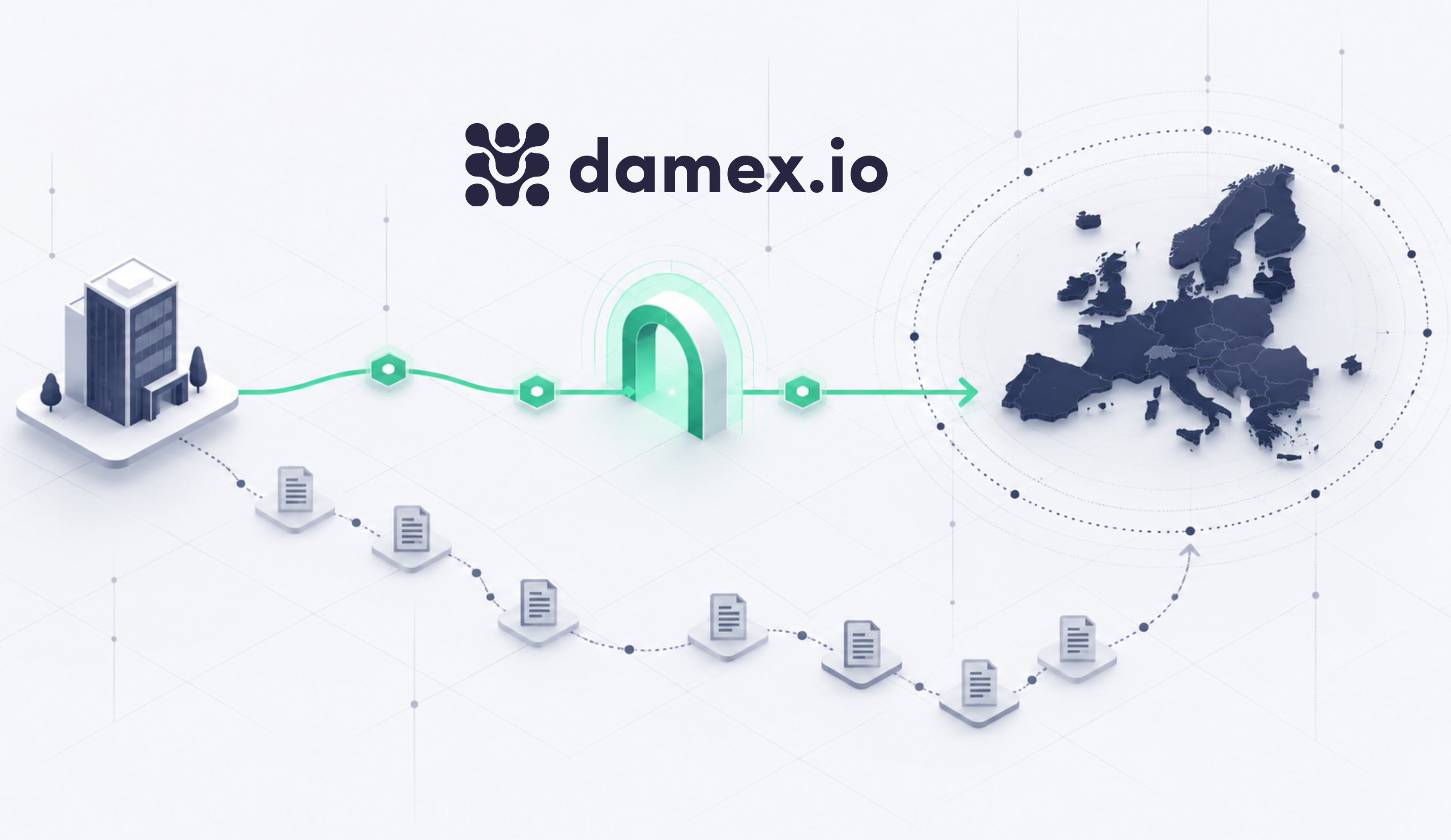
A non-EU business that wants to serve EU crypto-asset clients generally needs to operate within MiCA, but it does not always need its own licence to do so. The practical routes are to apply for its own MiCA authorisation, to work with a MiCA-authorised partner that already holds one, or, in narrow cases, to rely on limited exemptions. For most businesses that want to move quickly, working with an authorised partner is the fastest route to compliant EU access.
Why non-EU businesses cannot simply serve EU clients
MiCA applies to crypto-asset services provided within the EU, regardless of where the provider is based. A business in the US, UK, Switzerland, the UAE, Singapore or Latin America that markets to or serves EU clients is generally within scope. Being established outside the EU does not place a business outside MiCA requirements when it is doing business inside the EU.
The routes into the EU
There are three practical paths:
- Apply for your own MiCA authorisation: establish an EU entity and obtain a licence. Full independence, but slow and capital-intensive.
- Work with a MiCA-authorised partner: reach EU markets through a partner that already holds authorisation, within a regulated framework. Faster, with the authorisation held by the partner.
- Rely on a narrow exemption: in limited situations, such as genuine reverse solicitation, some activity may fall outside scope. These exemptions are narrow, easy to get wrong, and not a reliable basis for building a business.
Why the partner route is often the practical choice
For a non-EU business, standing up an EU entity and running a licence application can take a long time and significant capital, during which the EU opportunity waits. A MiCA-authorised partner shortens that path: the business reaches EU clients through the partner's regulated infrastructure while it decides whether to pursue its own licence later. The trade-offs are set out in our comparison of a MiCA licence versus a MiCA partner.
What to check before choosing a partner
Check the partner's exact authorisations and the services they cover, how your specific activity maps to those authorisations, the custody, AML and sanctions frameworks, how any payment or e-money services are provided and by which entity, and the jurisdictions where the arrangement is valid.
Where Damex fits
In respect of servicing within the EU, Damex Digital Ltd is authorised by the Malta Financial Services Authority as a Crypto-Asset Service Provider and a Financial Institution under MiCA and the FIA. A non-EU business can reach EU markets through Damex's regulated infrastructure.
Frequently asked questions
Can a non-EU company serve EU clients without a MiCA licence?
It generally needs to operate within MiCA, but not always with its own licence. It can work with a MiCA-authorised partner that already holds authorisation, which is often the fastest route to EU access.
Does MiCA apply to companies outside the EU?
MiCA applies to crypto-asset services provided within the EU regardless of where the provider is based. A non-EU business serving EU clients is generally in scope.
What is reverse solicitation under MiCA?
It is a narrow situation where a client approaches a provider entirely on their own initiative. It is limited, easily misapplied, and not a reliable basis for building an EU business.
How quickly can a non-EU business start serving EU clients through a partner?
It depends on onboarding and due diligence, but it is generally much faster than obtaining a licence directly. Speak to the provider to assess your case.
Disclaimer
This article is for information purposes only and does not constitute financial, investment, tax or legal advice. Crypto-assets and stablecoins are high risk. Their value can go down as well as up and you may lose the full value. Stablecoins, including e-money tokens and asset-referenced tokens, may lose their peg, and redemption rights are generally against the issuer, not Damex. Crypto-asset services are not covered by deposit guarantee or investor compensation schemes. In the EEA, crypto-asset services are provided by Damex Digital Ltd, authorised by the Malta Financial Services Authority as a CASP under MiCA (EU) 2023/1114. Crypto-asset services and payment services are provided under separate regulatory frameworks. Availability depends on your jurisdiction and is set out in the relevant terms and conditions.
Related reading
VASP licence vs CASP licence: what changed under MiCA
VASP registration was the old national model; a CASP authorisation is the MiCA model. Here is the difference, and what it means for a business that held a VASP registration before MiCA.
4 min read
MiCA passporting explained: one authorisation, the whole EU
MiCA passporting lets a firm authorised in one EU member state provide its services across the others. Here is how it works and why it matters for market access.
3 min read